All Events – listed as text

All Events

Events and Webinars Page

Advance Care Planning for Indigenous Communities


Part of the All Together ECHO Series

Presenter: Carol Fulcher, Program Coordinator + Community Liaison, Merritt and District Hospice Society

Compassionate Dementia Inclusive Communities


Part of the All Together ECHO Series

A sneak peek of how 3 social health movements Nav-CARE, dementia-inclusive movement and Compassionate Communities – are helping to empower and support people living with early-onset dementia, their families. An overview of ongoing project and stories from 6 Canadian communities at work who are raising awareness and helping to improve quality of life of people living with dementia and the care partners.

Presenter: Melody Jobse, Community Engagement Lead BCCPC and Community Development specialist, UBCO

Goals of Care in the Acute Care Setting: Drawing in the Team

Part of our Updated & Innovations in Essential Conversations for the Health Care Team ECHO Series.

Presenter: Dara Lewis, MSN(c), BSN, CHPCN Vancouver Coastal Health, Clinical Educator and Lead, Vancouver Acute
Goals of Care Support Team (previously RPACE)

ECHO evaluation: 2025 records highest participation ever

What a year it has been! The success of the ECHO program in 2025 was truly a collective achievement. With our internal leads, hub partners, and all involved, the ECHO team is so very grateful to everyone for creating thoughtful, engaging, and sometimes wonderfully unexpected sessions. Together, we’ve collaborated with familiar partners and experts in their fields, and we welcomed new voices from people with lived experience.

With the year now wrapped, we exceeded 2024’s registration and attendance numbers—continuing our year-over-year growth since ECHO began! In 2025,we offered 39 sessions, 4,292 people registered, 1,864 people attended, and 2,607 accessed session recordings on YouTube. Many participants attended multiple sessions across several series, choosing the learning that mattered most to them, when and how they wanted to access it.

Based on the registration data, nurses (22%) and social workers (21%) are the most frequent attendees across all sessions. Participants also include representatives from a wide range of roles, such as volunteers, spiritual care providers, music therapists, dietitians, paramedics, and others. Those attending provided care in diverse settings, including hospice (14%), long-term care (14%), and home and community care (34%). Learner participants found ECHO to be a valuable learning experience, with 83% reporting that the ECHO sessions increased their knowledge of the topic. As well, 86% of participants reported feeling confident in applying what they learned from the ECHO sessions. A real measure of ECHO’s success is that 92% of the participants would highly recommend the session they attended.

In the fall, the ECHO program team conducted interviews with learner participants. While post-session surveys are completed after every session, these interviews offer deeper, more nuanced insights into the program’s impact. The feedback has been inspiring – confirming that participants trust ECHO, value the speakers and content, and appreciate the opportunity to learn about others working in this space, and how they fit into the broader ecosystem of care. Word of mouth remains our strongest promotional tool, with interviewees sharing recordings, discussing lessons learned in team meetings, and encouraging colleagues to register each month.

We heard so much in support of the program. Here are just two standout quotes:

“It’s really beneficial to hear and feel supported by others working in the field who have far more experience than me, who have medical backgrounds or lived experience to share.”

“…it has reaffirmed that there’s value in the way that I think and the way that I approach the work that I do.”

Thank you all, including those who help plan, the presenters, and those that attend ECHO, for making this possible—and here’s to everything we’ll achieve together in 2026!

Neurodivergence, grief, and bereavement

Part of our Grief & Bereavement Literacy ECHO Series

This virtual session will have a presentation with Q & A. Session poster you can print and share linked here.

Presenter: Jess Holtslander, RSW, MSW, RCC, Sun & Clouds Counselling

This series is for anyone interested in increasing their knowledge around grief and bereavement to support them personally or in their professional careers.

Celebrating Volunteers: The Heart of Compassionate Communities

Building compassionate communities that are inclusive and responsive to the needs of older people living with declining health, including those living with dementia, starts with a focus on people—seeing neighbours, friends, and colleagues with dementia not as cases to be treated, but as individuals with unique strengths, passions, and contributions. In a country facing economic strain and an overstretched health-care system, projects like the Compassionate Dementia-Inclusive Community (CDIC) Initiative and the Compassionate Communities Volunteer Navigation (CCVN) Initiative remind us that social health—connection, empathy, and belonging—can be just as vital as medical care. And driving that message forward are countless volunteers whose compassion is fueling awareness and change across British Columbia.

To honour these change-makers (and to mark International Volunteer Day on December 5), we spoke with CDIC and CCVN coordinators from BC about the pivotal role volunteers play in their work.

Extending Community Compassion through Intergenerational Connection on Quadra

On Quadra Island, the Quadra Circle Community Connections Society and Way to Go group are working together to include the younger generation as a short- and long-term support for older people living with declining health — a theme revealed from the results from the Compassionate Community Index Survey completed for the CCVN project. Jude McCormick, one of the CCVN co-leads, explains that the Simple Sharings program, “came from the work of four dedicated volunteers who saw the need for relationship building between children and older people as a way of instilling compassion through lived experience – simply by sharing.”

These volunteers connected the after-school program with seniors housing to bring together young students and residents weekly to engage in activities for the remainder of the school year. According to McCormick, after the first session, one child was surprised that older people liked playing games with them. Even a very shy student got into making rhythms and sounds with a ball and stick (made by one of the older participants) on bowls, aluminum foil, and other materials provided for experimentation. While the program is still in its early stages, the children and older people are already making connections through shared interests in music, airplanes, baking, and storytelling. Conversations are sparking and plans are underway to share pictures and bake cookies.

The immediate results can be felt by the joyous interactions and smiling faces of the participants. The hope, according to McCormick, is for these moments to become lasting positive beliefs of the younger generation about the value of older people and for a sense of personal value for each older person as they share themselves with the children. “The foresight and willingness of our volunteers to make this idea a reality is to be celebrated!”

Sharing Stories, Building Safety in Trail

On the other side of the province, CDIC Coordinator Maggie Shirley from the Greater Trail Hospice Society has seen firsthand how storytelling transforms communities.

“When someone living with dementia shares their story, you might have other people living with dementia who hear it and then feel brave enough to share their stories too,” she said. “It’s empowering for the storyteller—and eye-opening and deeply moving for the listener.”

Shirley believes storytelling creates a ripple effect of safety and connection. “A lot of health issues are related to isolation, so connecting in community—building bridges—is so important.”

In mid-October, the Greater Trail Hospice Society and Beaver Valley Recreation hosted a five-hour dementia training workshop for community members, volunteers, and care partners, that did just that. The event drew a total of twelve participants: volunteers from places like Columbia Seniors Wellness Society and Trail Better at Home, as well as interested community members and care partners for people living with dementia.

The workshop explained the different kinds of dementia and their symptoms, then offered a candid discussion about the stigma associated with the condition and how communities can challenge it. After lunch, participants took part in a sensory deprivation simulation to better understand the daily challenges faced by people living with dementia. The day wrapped with some practical guidance on communicating effectively and respectfully with people with lived experience—making connection safe and inclusive.

For many, the most meaningful part of this training was hearing from care partners. Their lived experiences offered a deeper layer of understanding and authenticity to the course content that allowed everyone to listen with compassion, ask honest questions, and validate each other’s experiences. Their stories became the bridge Shirley talked about — the kind that fostered the connection and inclusion all communities should aspire to.

Connection and Companionship in Prince George

In Northern B.C., Laurie De Croos of the Prince George Hospice and Palliative Care Society and Gagandeep Kaur from Prince George Council of Seniors are focused on bringing people together through their CDIC coordination team.

Their initiative matches volunteers with clients for engaging, shared experiences like walks, football games, or museum visits. “It’s about companionship,” said De Croos. “Those moments of connection can change someone’s week.”

To include folks who prefer group interaction to a one-on-one experience, they host paint nights, picnics, and other activities that make the community feel accessible to everyone.

Kaur adds, “We also match volunteers with care partners who need someone to listen, to help them feel seen and supported, too.”

Through empathy, storytelling, and shared experiences, these volunteers are proving that inclusion doesn’t start with policy—it starts with people. And that is truly something to celebrate!

To all volunteers, across every field, initiative and cause, we salute you today and every day… Thank you for the change you create, the connections you foster, and the way you make the world a better place!

Compassionate Community Index in action

Over the past year, a team from UBC-Okanagan, in partnership with BCCPC, has worked with eight Canadian organizations to make their communities more compassionate. In the Compassionate Dementia-Inclusive Communities (CDIC) project, six of these organizations used a modified CCI to include a focus on persons living with dementia and care partners, while the two organizations in the Compassionate Communities Volunteer Navigation (CCVN) project used the original tool, focusing on compassion more broadly. The surveys were shared with collaborating advisory committees and other community stakeholders. From there, leadership teams from the organizations used survey results to give shape and direction to exciting new initiatives to foster more compassionate (and dementia-inclusive) communities across the board.

Sites found that completing the CCI survey helped them identify strengths and opportunities for growth to guide their actions towards building a Compassionate Community.

Community-tailored solutions

From the CDIC project, one notable example of this comes from the Progressive Intercultural Community Services Society (PICS) who are collaborating with Brella Community Services Society in Surrey, BC. They administered the survey in their community, which has a strong South Asian presence. From the open-ended questions, they identified the community’s deep sense of service, solidarity, and familial commitments. Further, the section on ‘attitudes & commitments’ reinforced that they have strong community values and a commitment to inclusion. Leveraging these strengths, the inter-organizational team developed culturally driven dementia education sessions, a Seva ambassador program, and a community champion network. The process of recognizing and harnessing their strengths also provided a strong foundation for building new opportunities. The ‘Network & Connections’ ideal, for example, highlighted infrastructure gaps without platforms to connect services, volunteers, and those needing support. So, the team designed culturally appropriate interventions that could help close the gap. They created a dementia support group called Sanjh support, (“Sanj” means “unity”), a caregiver support circle known as Chai & Chat, and a Community Dementia Navigator program.

About the Index…

The Compassionate Community Index (CCI)—developed by the BC Centre for Palliative Care (BCCPC) and the Kalein Centre—helps communities assess how prepared and committed they are to support people through declining health, caregiving, dying, and grieving. This tool guides collective brainstorming on harnessing the strengths a community already has and intensifying efforts where there’s still room for growth.

The survey focuses on five key ideals:

  • Awareness & Advocacy: how well does your community understand and promote compassionate care?
  • Attitude & Commitment: how open is your community to conversations about dying, death, and caregiving?
  • Leadership & Capacity: does your community already have a strong presence of leaders and volunteers driving compassionate initiatives?
  • Networks & Connections: how strong are the social support systems and community relationships where you live?
  • Opportunities & Recognition: how does your community celebrate compassionate efforts and identify new opportunities to help those efforts grow?

Each ideal is explored through a series of five statements on which participants can rate their community. The six-point scale starts at “don’t know”, “not yet started”, and “just started”, moving towards “on the road”, “nearly there”, and finally “we’re there”. The survey also includes four open-ended questions:

  1. What are three words, phrases, or adjectives that best describe our community?
  2. We best show we are a Compassionate Community by…
  3. What are three significant challenges hindering development of a Compassionate Community?
  4. What are three underdeveloped opportunities around a Compassionate Community?

Results then provide a community-specific guide for building a more compassionate community where you live.

From the CCVN project on Quadra Island, a 16-person Advisory Committee completed the CCI survey, facilitated by the Co-Leadership team from Quadra Circle Community Connections Society and Way to Go. The results pointed to a need for more organized collaboration between community services and clearer ways to inform the community about available supports. Using an already established neighbourhood mapping system developed by the local emergency preparedness program, they decided to develop a new outreach service called Compassionate Neighbourhoods whereby trained volunteer Neighbourhood Advocates will be assigned to specific neighbourhoods to be available to assist persons to access non-disaster related support when needed.

Other survey results highlighted a need to listen to children and help them develop positive connections with older persons so they, as future adults, would have more compassion for those experiencing declining health. As one co-lead noted, “There seemed to be a cry of concern [that] if we didn’t pay attention to youth and get them involved with their community elders, the base of compassion [would] not continue beyond a couple of generations.” This finding inspired “Simple Sharings,” an intergenerational program bringing older people and children together every two weeks for shared activities to increase curiosity and knowledge exchange across generations.

Lastly, the “undeveloped opportunities” portion of the survey noted that further community education would be a powerful way to address gaps. The Continued Learning Initiative now includes Nav-CARE training for all, more education on Compassionate Communities and Palliative Care, and increased PR about existing services.

UBC Okanagan’s team is excited to walk alongside Brella, PICS, Quadra Circle, and the Way to Go Society, along with all our other organizations, and support them as their work unfolds. Over the next year, their activities will generate valuable insights into how compassionate and/or dementia-inclusive communities can enhance quality of life for aging individuals.


No Fixed Address: White Cart Memorial screenings bring community together

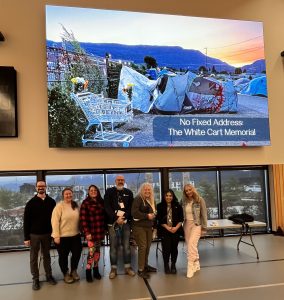
From the BC Centre for Palliative Care and the Kelowna Homelessness Research Centre (KHRC), No Fixed Address: The White Cart Memorial is a powerful and intimate documentary that sheds light on a deeply overlooked aspect of the homelessness crisis: people’s grief following the death of someone they care about.

The film weaves together research, personal lived experience testimonies, community organization reflections, and future action plans in Kelowna, British Columbia. This film captures the emotional and logistical challenges of grieving in public spaces.

Screenings were a success for bringing the community together!

Over seven screenings to more than 350 people in 2025, the film has had a meaningful and impactful success. Highlighting the urgent need for compassionate support and informed services, the screenings – with facilitated discussions afterward – brought together community groups, organizations, and professionals committed to addressing these issues.

Many attendees expressed how important it was to see these themes represented openly and sensitively, often noting the impact it would have on how they move forward in both their personal and professional lives.

Special thanks to the panelists consisting of bereavement experts, community social workers, Elders, and people with living and lived experience for their valuable insights. Their openness and courage added depth and authenticity to the conversation. We would also like to thank our various partners in supporting the screenings, especially the KHRC and Community Action Initiative (CAI).

Want to learn more?

To learn more about the film and upcoming screenings in 2026, please visit www.whitecart.ca.

Watch the trailer here.

If you would like to connect with us to discuss the work or to inquire about hosting a screening of the documentary in your community, please send an email to Joshua Black at jblack@bc-cpc.ca.

No Fixed Address: White Cart Memorial screenings bring community together
Joshua Black and Stephanie Laing at the Port Alberni screening of No Fixed Address: the White Cart Memorial
No Fixed Address: White Cart Memorial screenings bring community together
Screening of No Fixed Address: the White Cart Memorial in Port Alberni

What people are saying about ECHO

Checking in with past ECHO participants to better understand their experience is a key step to making the program even better as we enter 2026. We heard about enablers and barriers to attending, impact on their practice, and the value of ECHO as a community of practice.

In total, 21 people accepted the invitation to be interviewed (16 from BC, 2 from Alberta and 2 from Ontario). Professions included physicians, nurses, clinical educators, social workers, Executive Directors, and volunteers, a funeral director, an end-of-life doula, and care coordinators. The care settings represented included long-term care, hospice, acute care, palliative care units and community care.

What we heard:

  • ECHO is an accessible way to recieve education and connect with other care providers. Participants appreciated the enablers — free, scheduled during lunch breaks, short duration, and they don’t need to seek permission or backfill to attend
  • Content and speakers were trusted and validated
  • ECHO sessions provide an opportunity to learn about and from others – what services they offer and how they connect to the ecosystem of care.

In their own words:

About the ECHO experience

” It’s really beneficial to hear and feel supported by others working in the field who have far more experience than I, who have medical backgrounds or lived experience to share.”

“…being able to come and discuss with other professionals in a similar vein has been really beneficial. It reinforces that where I’m at and current standards are in alignment, which is very helpful for me… I would say it has reaffirmed the value of the way I think and the way I approach the work I do. So it builds confidence and also some of these discussions and whatnot, even if I don’t agree with them, they’re great for conversation starters or thinking on other perspectives.”

When asked if ECHO contributes to their own self-efficacy, their belief in their abilities and experience

“….we’re on the right path, and we’re doing the right things. And people are asking for what we’re doing, so I think we must be doing something right. That’s definitely very encouraging for sure.”

When asked if they have applied what they learned:

“Absolutely. I think there’s always things, ways of approaching things. So I always like to hear, even if it’s just links to resources or other things I haven’t heard about, because there’s a lot of information out there that I haven’t heard about… So I really appreciate hearing different things and hearing different approaches to care and approaches to psychosocial support.”

When asked about the accessibility of ECHO:

…” Therein lies the benefit of the virtual aspect … I don’t have to factor in commute time, parking, fees, all that kind of stuff, and so it’s right at my fingertips within whatever care site I happen to be on that day. So long as I have my phone or a computer, I can join.”

“… there are people in rural areas who can’t get to the main centres to attend education. It’s just not an option, whether it’s not funded or they just don’t have time or they’re not backfilled or it’s more than a day travel to get to where the conference would be. I think the virtual option has really given an opportunity for people to have access to education, especially in rural communities.”

Want to learn more and participate in ECHO. Please contact us at echo@bc-cpc.ca. You can also check our webpage for upcoming session information.
We post a number of our past sessions on our YouTube channel.

We look forward to continuing to work with our partners who put so much energy and effort into crafting evidence-based sessions that spark conversation and connection with our participants.

Flexing Your Core ECHO-The Leading Edge

Part of our Flexing Your Core ECHO series

In this session we will identify and discuss common issues in palliative care, and we will talk through steps to take in addressing ethical issues by discussing a case scenario. Participants will have the opportunity to reflect on how education, evaluation, QI and research are important in palliative care contexts.
Competency domains: Professional & Ethical Practice; Education, Evaluation, Quality Improvement, Research

Scroll to Top
Verified by MonsterInsights