
All Events
Events and Webinars Page
(no title)
Save the Date: A Special Hospice Palliative Care Week Presentation is Coming Up!
Providence Health Care staff and partners across the region are invited to join a special presentation for Hospice Palliative Care Week on Tuesday, May 5, 2026, 12:00-1:15 pm featuring a joint presentation by Dr. Sarah Levitt and Dr. Daniel Buchman.
This session, “Towards a Palliative Psychiatry for Severe and Persistent Mental Illness,” will explore the emerging field of palliative psychiatry, tracing its development over the past 15 years. The speakers will discuss key ethical considerations and outline future directions for advancing this innovative approach to mental health care.
Format: In-person and Zoom
Main In-Person Location
St. Paul’s Hospital – Cullen Family Theatre (1st floor)
Zoom Access
Link: https://us02web.zoom.us/j/86566043119
Webinar ID: 865 6604 3119
Join by Phone: +1 778 907 2071
Save the date Special Hospice Palliative Care week presentation
Palliative Essentials in LTC ECHO: Person centered symptom management – addressing pain
Person centred pain management in long term care is a core palliative essential. Untreated pain in frail older adults leads to significant distress, functional decline, pain behaviours, and reduces quality of life. This ECHO session focuses on effective pain management starting with understanding the resident’s goals of care and highlighting timely assessment including the use of behaviour based tools such as PAINAD for residents with dementia, as well as appropriate use of analgesics including opioids, addressing common fears about pain medications and strategies for effective communication with prescribers.
Presenters: Jennifer Walker, Palliative Care Physician, Lions Gate Hospital and North Shore Hospice; Coastal Medical Lead for LTC (North Shore)
Gita Rafiee, Clinical Nurse Specialist, Fraser Health Authority for Long-Term Care & Assisted Living

Palliative Essentials in LTC: Conversations — Aligning Care with What Matters
Connecting with residents is key to understanding who they are, what matters most to their quality of life, and how care can align with their values and preferences. This ECHO session focuses on goals of care conversations as a way to understand each resident as a unique person, support their understanding of their health, and explore care options. It also highlights how discussing expected changes can help residents and care partners prepare for what lies ahead, including preferences for where care is provided and reassurance that long-term care teams can support end-of-life care when needed.
Presenters:
Jennifer Walker, Palliative Care Physician, Lions Gate Hospital and North Shore Hospice; Coastal Medical Lead for LTC (North Shore)
Monica Kelly, MSW, RSW Lead, Goals of Care Support Team, VCH
Honouring Grief in Long-Term Care Communities: Struggles and Strategies
Part of our Grief & Bereavement Literacy ECHO Series
In long-term care homes, grief is not a single moment tied only to death. It is an ongoing, layered experience shared by the entire long-term care village: residents, families, staff, volunteers, and all who are connected to the home. Losses of independence, identity, memory, relationships, and familiar roles often begin long before the end of life, especially for people living with dementia. Yet despite the deep emotional impact of these cumulative losses, grief frequently goes unrecognized in long-term care due to time pressures, limited resources, and a lack of formal support. This session brings together lived experiences from BC long-term care communities, research-informed insights, and practical strategies to help care homes acknowledge, normalize, and compassionately respond to grief as an everyday part of life and care. Session poster you can print and share linked here.
Presenters:
Lisa Dawson – President of the Independent Long-Term Care Councils Association of BC
Grace Hu, MPH – Research Coordinator, BC Centre for Palliative Care
Gita Rafiee, RN, BScN, MN, GNC(C), CNCA – Clinical Nurse Specialist Long-Term Care at Fraser Health Authority
Naoko Watanabe, MSW, RCSW, Social Worker at Minoru Residence
This series is for anyone interested in increasing their knowledge around grief and bereavement to support them personally or in their professional careers.
No Fixed Address: the screening experience in Chilliwack
On February 26, 2026, we were grateful to be part of a team that hosted a half-day sold-out educational event at the The’í:tselíya – S.A.Y. Health & Community Centre in Chilliwack, BC. The event was aimed at addressing the critical gap in grief and bereavement support for people experiencing homelessness and the community support workers who serve them.
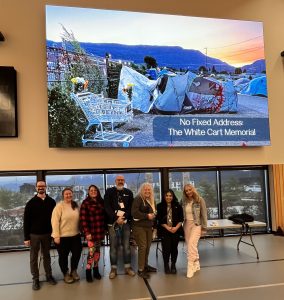 The event featured a screening of the documentary No Fixed Address: The White Cart Memorial, highlighting how homelessness shapes experiences of loss, and the professional grief carried by support workers who work with this population. A panel discussion followed, bringing together:
- individuals with lived experience (Darla and Rachel)
- frontline staff from Pacific Community Resources Society (Jason)
- frontline staff from Qwi:qwelstom mental health and wellness team (Tyneshia)
- director of programs from the Chilliwack Hospice Society (Lucy)
The panel explored community-specific strategies, challenges, and emerging practices in supporting grief in the community. The event also introduced our new, free e-learning course, Navigating Grief and Bereavement in the Context of Homelessness: A Guide for Community Support Workers.
The event’s impact
Over 100 people attended this highly successful event.
Our post-event survey results indicated strong positive impacts in increasing attendees’ understanding of grief among people experiencing homelessness and in the workplace for community support workers, and the importance of grief support in these contexts. People also emphasized the emotional and practical impact of hearing personal stories from people with lived experience and appreciated the combination of film and panel discussion.
The event fostered community dialogue and support for ongoing initiatives, including the creation of a memorial for people experiencing homelessness in Chilliwack, which received unanimous backing from survey respondents.
Overall, the event had a meaningful impact on the community, increasing grief literacy among attendees about the grief experienced by people experiencing homelessness and community support workers.
Acknowledgements
We were able to have this event thanks to funding from the Chilliwack Social Research and Planning Council through its Community Engagement and Knowledge Mobilization Micro-Grant, BCCPC, the KHRC, the Vancouver Foundation, and the Community Action Initiative. We have also received in-kind support from the Pacific Community Resources Society, Chilliwack Community Action Team, Homelessness Services Association of BC, and Chilliwack Hospice Society.
We would also like to thank all those who shared their stories and knowledge on the panel. Additionally, Chief Darcy Paul of Sq’ewqéyl (Skowkale) First Nation, who provided the event with a lovely welcome, and Joanne Jefferson (manager of the Qwi:qwelstom mental health and wellness team), who closed the event with such tenderness and provided Indigenous traditional medicine (Cedar brushing) to those leaving the event.
For more information about the film, and a list of upcoming screenings, please visit whitecart.ca.
Palliative Essentials in LTC ECHO: Foundations and Care Planning
Learn how to integrate a palliative approach into long term care from move-in, with a focus on what matters most to residents and their families. This session introduces the foundations of a palliative approach, supports clinicians in adopting care planning that prepares for both current needs and anticipated changes, and highlights the new Palliative Essentials education available for staff working in LTC.
Presenters:
Gita Rafiee, Clinical Nurse Specialist, Fraser Health Authority for Long-Term Care & Assisted Living
Frances Wright, Palliative Outreach and Consult Team Nurse, Providence Health Care
Connecting Minds Through Compassionate Hearts
Part of the All Together ECHO Series
Join us to learn how community minded partners are building an dementia-inclusive culture to help reduce stigma, raising awareness and empowering supports for people living with early dementia to age in place..
Presenters:
- Erin Connelly, Operations Director, Prince George Hospice Palliative Care Society
- Laurie De Croos, Community Programs, Prince George Hospice Palliative Care Society


Grief and Caregiving: Difficult Conversations and Decisions in Dementia Care
Part of our Grief & Bereavement Literacy ECHO Series
Dementia caregiving is often shaped by ongoing and anticipatory grief, as families experience repeated losses long before end of life. This session examines how both grief and dementia can impact challenging discussions regarding safety, personal independence, and end-of-life matters. It offers practical strategies to help caregivers approach these decisions with compassion, clarity, and confidence. Session poster you can print and share linked here.
Presenter: Krista Hill, MSc Dementia, BEd – Executive Director of the BC Dementia Care Society
This series is for anyone interested in increasing their knowledge around grief and bereavement to support them personally or in their professional careers.
A Community Collaboration: The Sunshine Coast Hospice Green Sleeve Advance Care Planning Program
Session resources
- Recording: YouTube
- Session summary notes
Part of the All Together ECHO Series
Sunshine Coast Hospice Society (SCHS) developed their Green Sleeve program in 2020 as a collaboration with local physicians, paramedics and home care nurses. It started out as a COVID pilot project and has become a core Hospice program. This session will review how the Green Sleeve works as part of the advance care planning program in our semi-rural community. We will review the benefits, successes and challenges and will look forward to sharing ideas and experiences with the audience around advance care planning in their respective communities.
Presenter: Jackie Scott, Volunteer
Manager, Green Sleeve ACP Program, Sunshine Coast Hospice
